
FIELD NOTES / 03
Units & measures
US customary to metric, with the right units attached.
Keep the unit attached to the number
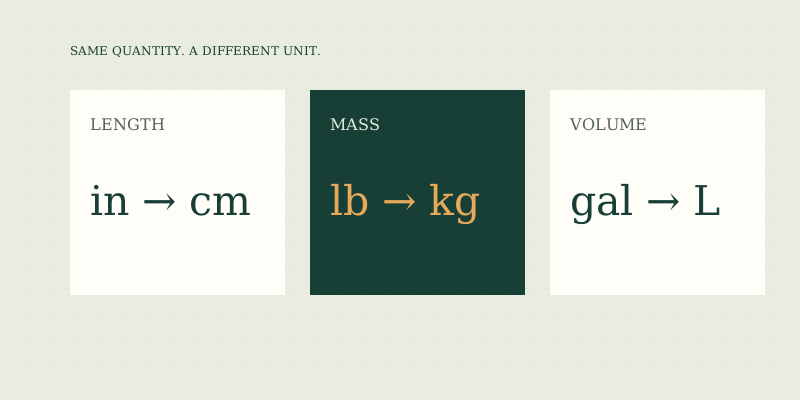
These guides explain conversions between selected US customary and metric units. They begin with the type of quantity: length, mass, volume, area, or temperature. The converter groups compatible units and shows its factor or formula so you can check what happened to the input. Start with unit-conversion basics if you are unsure whether to multiply or divide. The length guide handles mixed feet and inches. The mass guide distinguishes ordinary ounces from fluid or troy ounces. The liquid-volume guide names the US customary definitions used here. Area requires squared factors, while temperature requires an offset as well as a scale change. The density guide explains an important boundary: cups cannot be converted directly to grams without a relevant material relationship. This tool does not supply ingredient densities, medical doses, engineering certification, or legal measurement standards. An exact unit factor does not make an approximate reading exact. Preserve the source measurement, its definition, and appropriate precision, and consult the governing specification or a qualified professional when the result has safety or regulatory consequences.
Square feet, square meters, acres, and hectares
Convert area with squared length factors, calculate rectangular examples, and distinguish numerical area from usable or legally defined space.
Inches, feet, and centimeters: convert length clearly
Convert US customary lengths to metric, handle feet-and-inches inputs, and keep linear dimensions distinct from area and volume.
Pounds, ounces, grams, and kilograms: convert mass
Convert avoirdupois pounds and ounces to metric mass, combine mixed units correctly, and avoid confusing mass ounces with fluid or troy ounces.
Fahrenheit, Celsius, and kelvin: offsets matter
Convert absolute temperature readings with the correct offset and scale, and distinguish readings from temperature differences.
Unit conversions: match the quantity before the number
Choose compatible units, cancel conversion factors correctly, and distinguish length, area, volume, mass, and temperature before converting.
US cups, fluid ounces, gallons, and liters
Convert US customary liquid volumes to metric, distinguish cup definitions, and keep Imperial, dry, and mass measures out of liquid calculations.
Why cups do not convert directly to grams
Use density to connect volume and mass, understand ingredient and packing differences, and avoid a universal cup-to-gram conversion.