
FIELD NOTES / Units & measures
Unit conversions: match the quantity before the number
A reliable conversion starts by identifying what is being measured. Length converts to length, mass to mass, and volume to volume. Multiplying by a conversion factor changes the unit while preserving the quantity. It does not turn a cup of material into a mass unless you also know an appropriate density.
Identify the measurement type
The unit converter groups units by length, mass, volume, area, and temperature. Those groups prevent obvious mismatches such as converting inches directly to square meters or fluid ounces directly to grams. A familiar word such as ounce is not enough to identify the quantity; its full label matters.
| Quantity | Example input | Compatible target | Not directly compatible |
|---|---|---|---|
| Length | Inches | Centimeters | Square centimeters |
| Mass | Pounds | Kilograms | Liters |
| Volume | US fluid ounces | Milliliters | Ounces of mass |
| Area | Square feet | Square meters | Meters |
| Temperature | Degrees Fahrenheit | Degrees Celsius | A length unit |
Temperature needs special treatment because the scales have different zero points. The other supported groups convert by multiplying and dividing factors; temperature conversion also adds or subtracts an offset.
Arrange the factor so units cancel
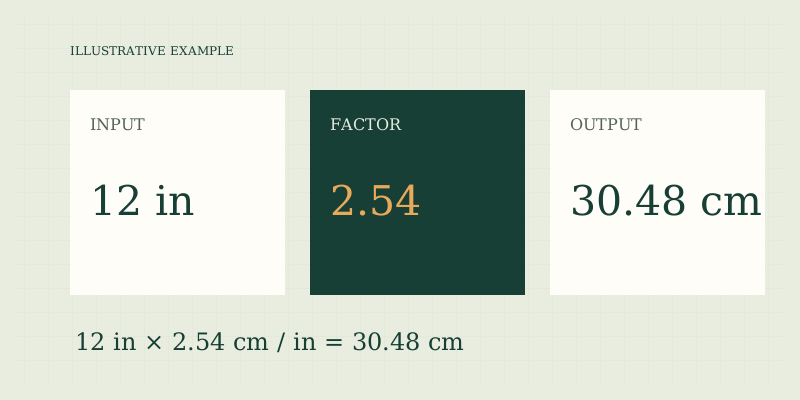
For an illustrative length of 12 inches, use 2.54 centimeters per inch. The calculation is 12 in × 2.54 cm/in = 30.48 cm. The inch units cancel, leaving centimeters. Reversing the factor would leave the wrong unit structure and a wrong numerical answer. For the reverse direction, divide by 2.54: 30.48 cm ÷ 2.54 cm/in = 12 in. This dimensional check is useful when you cannot remember whether to multiply or divide. Write the units in the fraction and choose the orientation that cancels the starting unit.
Convert through a common base
The tool stores each length factor in meters, each mass factor in kilograms, each volume factor in liters, and each area factor in square meters. It multiplies the entered value by the starting unit factor and divides by the destination unit factor. This avoids maintaining a separate factor for every pair of units. An illustrative 3 feet to centimeters calculation becomes 3 × 0.3048 meters per foot ÷ 0.01 meters per centimeter = 91.44 centimeters. The intermediate base unit cancels. You can check the answer through inches as well: 3 feet × 12 inches per foot × 2.54 centimeters per inch gives the same result.
Pay attention to powers of units
An area is a product of two lengths. If one meter equals 100 centimeters, one square meter equals 100 × 100 = 10,000 square centimeters. A volume involves three dimensions, so a cubic conversion uses the factor three times. Using a length factor only once for an area or volume produces a large error. This site's area group handles square feet, square yards, acres, square meters, and hectares. Its volume group handles selected liquid units and metric volume units. It does not offer every possible cubic, survey, historical, or industrial unit. If your source uses a specialized definition, obtain that definition before converting.
Distinguish exact factors from exact measurements
Some unit relationships are defined exactly, but your reading may still be approximate. A ruler reading of about 12 inches does not become an exact 30.48-centimeter measurement simply because the conversion factor has an exact definition. Carry enough digits internally, then report precision consistent with the original measurement. The converter displays up to ten significant digits. That is a software formatting choice, not a certification of measurement quality. Do not use all displayed digits in a building tolerance, scientific result, or product specification unless the original data and applicable standard support them. Seek qualified guidance for regulated or safety-critical use.
Use a conversion checklist
- Read the full unit label, including liquid, mass, square, or cubic qualifiers.
- Confirm that the starting and destination units measure the same quantity.
- Check whether a regional or historical definition is involved.
- Arrange the factor so the original units cancel.
- Estimate the order of magnitude before accepting the result.
- Convert back as a quick consistency check.
- Round the displayed result to match the input quality.
A conversion does not validate a quantity, a product claim, or a measuring instrument. It simply expresses the supplied quantity in another compatible unit under the chosen definitions. For a contract, label, drawing, or laboratory method, the governing specification controls.
Explore the measurement field notes
Read inches, feet, and centimeters for length, pounds and kilograms for mass, and US cups and liters for liquid volume. Use temperature conversion for offsets, area conversion for squared factors, and density and cooking measures when a recipe crosses volume and mass. The unit converter shows its working formula.
FAQ
Can I convert any two units with a factor?
Only if they measure compatible quantities and their definitions are known. Different measurement types may require another physical relationship, such as density, rather than a universal factor.
Why does the result have more digits than my input?
The software displays a consistent numerical precision. You should still round appropriately for the original measurement and the purpose of the result.
Is a US gallon the same as an Imperial gallon?
No. This tool explicitly uses US liquid gallons. Do not use its gallon result for a source that specifies Imperial or US dry measures.
Sources
- NIST: SI conversion factors, Appendix B.8 — conversion-factor reference.
- Sources and methods — implemented units and precision.
Put the method to work.
Open calculator ↗