
FIELD NOTES / Units & measures
Why cups do not convert directly to grams
Cups measure volume and grams measure mass. To convert between them, you need a density appropriate to the material or a reliable ingredient-specific measured relationship. There is no universal number of grams in a cup. The unit converter keeps mass and volume separate so it does not imply that such a universal conversion exists.
Use the density relationship
Mass equals density multiplied by volume. If density is expressed in grams per milliliter and volume is in milliliters, their product is grams. To recover volume from mass, divide mass by the same appropriate density. The units should cancel in the written calculation.
| Illustrative quantity | Unit | Role |
|---|---|---|
| Volume | mL | Space occupied |
| Density | g/mL | Mass per volume |
| Mass | g | Volume multiplied by density |
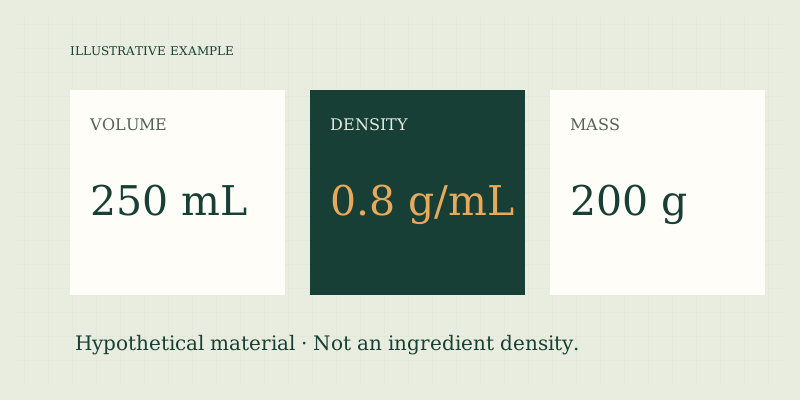
For a deliberately hypothetical material with density 0.8 g/mL, an illustrative 250 mL has mass 250 × 0.8 = 200 g. This density is a teaching input, not a measured value for oil, flour, or any named ingredient. Do not use it as a cooking or laboratory reference.
Convert the volume unit first
If the source gives US customary cups, convert those cups to milliliters using the specified cup definition. One such cup in this tool is 236.5882365 mL. Multiply that volume by the material-specific density only after confirming that the density uses compatible units. For the hypothetical density above, one US customary cup would have mass 236.5882365 × 0.8 = 189.2705892 g. The long decimal demonstrates the arithmetic, not practical measuring precision. A real ingredient may have a different density, and a real measuring cup may not support that level of precision.
Packing changes dry-ingredient measurements
A dry ingredient can occupy more or less volume depending on particle size, settling, compression, and how the cup is filled. A recipe specifying sifted, packed, or loosely spooned material is describing part of the measurement method, not decorative wording. Using a different technique can change the mass in the same nominal cup. For a recipe that supplies tested gram quantities, use those quantities rather than deriving a universal density from another recipe. If only a volume quantity is supplied, follow the stated filling method. This site does not publish ingredient-density tables or claim that one cup-to-gram relationship works for every product and preparation.
Conditions and composition matter
Density can depend on temperature, composition, moisture, and other conditions. A value from a reference is useful only when it applies sufficiently well to the actual material and purpose. Mixing two ingredients or changing concentration can invalidate a simple assumed relationship. For laboratory, industrial, medical, or safety-critical tasks, use the relevant method, product data, and qualified guidance. A general educational formula is not a substitute for controlled measurement or a validated procedure. Do not infer a safe dose or process setting from a kitchen-volume conversion.
Distinguish measurement from estimation
If you weigh an actual ingredient portion with an appropriate scale, you obtain a mass measurement under that method. If you multiply a nominal volume by an approximate density, you obtain an estimate. Both can be useful, but they should not be described as having identical certainty. Label a density-based result approximate when the density or volume is approximate. Keep the material name, conditions, source, and unit definition with the calculation. Reporting only a gram number loses the assumptions needed to reproduce it. Extra decimal places from a calculator do not remove uncertainty in the ingredient or measuring method.
Check common mistakes
Do not equate an ounce of mass with a fluid ounce because they share a word. Do not use a kilogram-per-liter density directly with a milliliter volume without adjusting units. Do not assume an unspecified cup means the US customary cup used here. Do not combine a packed ingredient's density with an unpacked volume and present the result as exact. A dimensional check catches many of these errors. Write volume × mass/volume and confirm the volume units cancel. If they do not, convert one quantity before multiplying. Then estimate the order of magnitude and compare with a direct measurement if the result matters.
A density-based conversion checklist
- Identify the material and the purpose of the estimate.
- Confirm the volume-unit definition.
- Obtain a relevant density or tested ingredient relationship.
- Check the temperature, composition, and packing assumptions.
- Convert volume and density into compatible units.
- Multiply for mass, or divide for volume.
- Label the result with appropriate precision and uncertainty.
The unit converter handles the compatible-unit steps but intentionally does not supply a density. Return to unit basics, read US liquid volumes for cup definitions, and mass conversions for ounces and grams.
FAQ
Why is there no cup-to-gram button?
Because the answer depends on the material and measurement conditions. A generic button would hide an essential input and could return a misleading number.
Can I use a density from a different ingredient?
Not as a reliable conversion. Similar appearance does not establish equal density. Use a relevant measured relationship or weigh the actual portion with an appropriate method.
Does a precise volume conversion make the mass precise?
No. The density and original measurement may be approximate. The final result cannot be more trustworthy than those assumptions justify.
Sources
- NIST: SI conversion factors, Appendix B.8 — compatible mass and volume unit factors, not ingredient densities.
- Sources and methods — no density dataset is supplied.
Put the method to work.
Open calculator ↗