
FIELD NOTES / Units & measures
Inches, feet, and centimeters: convert length clearly
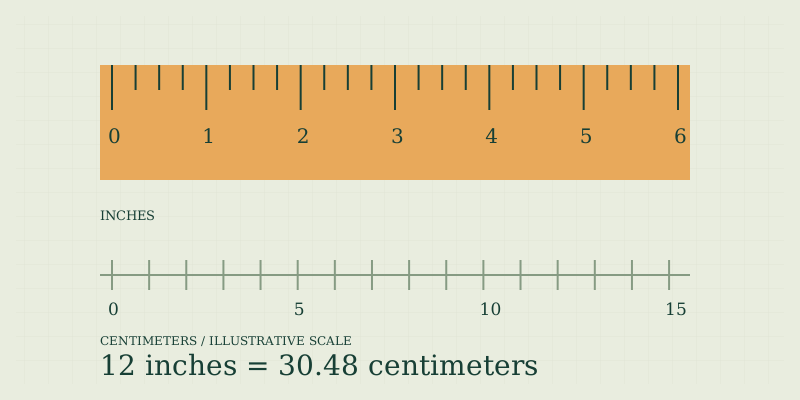
Convert inches to centimeters by multiplying by 2.54. Convert feet to meters by multiplying by 0.3048. Before using either relationship, check whether the input is a decimal length or a feet-and-inches notation. An illustrative 5 feet 8 inches is 68 inches, not 5.8 feet.
Convert a single linear measurement
For an illustrative 12-inch length, 12 × 2.54 = 30.48 centimeters. The reverse is 30.48 ÷ 2.54 = 12 inches. A conversion factor should be oriented so that the starting unit cancels and the destination unit remains.
| Illustrative length | Calculation | Converted length |
|---|---|---|
| 1 inch | 1 × 2.54 | 2.54 cm |
| 12 inches | 12 × 2.54 | 30.48 cm |
| 3 feet | 3 × 0.3048 | 0.9144 m |
| 1 mile | 1 × 1.609344 | 1.609344 km |
These examples use the international definitions represented in the converter. Survey-foot and historical variants are outside its scope. If a land record or engineering document specifies a specialized unit, do not assume the ordinary foot entry matches it.
Combine feet and inches first
For 5 feet 8 inches, multiply the feet by 12 and add the remaining inches: 5 × 12 + 8 = 68 inches. Then convert: 68 × 2.54 = 172.72 centimeters. By contrast, 5.8 feet equals 5 feet plus 0.8 × 12 = 9.6 inches, producing 176.784 centimeters. The converter accepts a single decimal quantity at a time. It does not parse a string such as 5'8" or a mixed fraction. Convert the components first, or enter total inches. For an illustrative 2 feet 3.5 inches, the total is 27.5 inches. Preserve the fractional inch as a decimal rather than dropping it.
Handle fractional inches deliberately
One half inch is 0.5 inch, one quarter is 0.25, and three eighths is 0.375. Convert the fraction by dividing its numerator by its denominator, then combine it with any whole inches. An illustrative 4 and 3/8 inches becomes 4.375 inches. Do not type 4.38 merely because the fraction looks like 3 over 8. That is a different value. If the fraction comes from a rough tape reading, the final metric report should reflect that reading quality. An exact fraction-to-decimal conversion does not eliminate uncertainty in where the tape was placed.
Convert each dimension of an object
For a rectangular object, convert length and width separately when reporting dimensions. An illustrative panel measuring 12 by 24 inches becomes 30.48 by 60.96 centimeters. If you need area, multiply compatible lengths or use the area group. Do not multiply a square-foot value by a linear foot-to-meter factor. An object can also have nominal and actual dimensions, tolerances, or a stated orientation. Conversion does not resolve those differences. For purchases or fitting parts, use the specification that defines which dimension is measured and how much clearance is needed. A mathematically correct conversion may still describe the wrong feature.
Sanity-check the size
Because one inch is more than two centimeters, a centimeter number should be larger than the equivalent inch number. Because one meter is longer than one foot, a meter number should be smaller than the equivalent foot number. These rough comparisons can catch an inverted factor or a mislabeled field. The reverse conversion is another useful test. Convert the result back to the original unit using unrounded values where possible. Small differences after rounding are expected. A large discrepancy usually indicates a wrong unit, a dropped component, or a factor applied in the wrong direction.
A length-conversion checklist
- Identify whether the value is decimal feet, total inches, or mixed feet and inches.
- Convert fractional inches numerically before entering them.
- Read the full source definition for specialized or historical units.
- Keep length separate from square and cubic measures.
- Convert every required dimension, not only the longest side.
- Preserve enough precision internally and report appropriate final precision.
- Check the physical fit or governing specification independently.
Use length mode in the unit converter. Return to unit-conversion basics for dimensional checks. Read area conversions for squared factors and mass conversions when a specification includes package weight as well as size.
Do not combine rounded sides too early
If both sides of an illustrative object are converted and rounded before an area calculation, the product can differ from converting the unrounded area. Keep the original side readings and unrounded conversions while doing the arithmetic, then round the final dimensions or area for presentation. When a specification gives tolerances, preserve those tolerances separately; converting the central value alone does not describe the full permitted size range. A fit decision may depend on those limits as much as on the nominal number.
FAQ
Is 5.8 feet the same as 5 feet 8 inches?
No. The decimal portion is a fraction of a foot. Multiply 0.8 by 12 to get 9.6 inches. Use total inches to avoid this ambiguity.
Can the tool read a fraction such as 3/8?
No. Divide 3 by 8 first and enter 0.375. The numerical input accepts decimals, not fraction notation.
Should I round to the nearest millimeter?
Only if that precision fits the original measurement and purpose. Follow the drawing, label, instrument, or relevant standard for consequential work rather than adopting a universal rounding rule.
Sources
- NIST: SI conversion factors, Appendix B.8 — international length relationships.
- Sources and methods — tool unit scope and display precision.
Put the method to work.
Open calculator ↗