
FIELD NOTES / Units & measures
Square feet, square meters, acres, and hectares
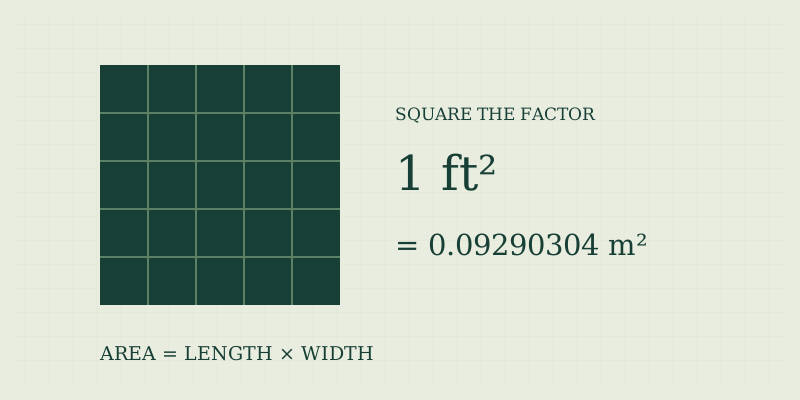
Convert square feet to square meters by multiplying by 0.09290304. The factor is the square of the foot-to-meter relationship, not the linear factor itself. An illustrative 100-square-foot area is 9.290304 square meters. Area conversions preserve the measured area but do not define which boundaries should be included.
Square the length factor
A square one foot on each side has an area of one square foot. Each side is 0.3048 meter, so the area is 0.3048 × 0.3048 = 0.09290304 square meter. Applying 0.3048 only once to a square-foot value confuses length with area.
| Illustrative area | Conversion | Result |
|---|---|---|
| 100 ft² | 100 × 0.09290304 | 9.290304 m² |
| 1 yd² | 1 × 0.83612736 | 0.83612736 m² |
| 1 acre | 1 × 4046.8564224 | 4046.8564224 m² |
| 1 hectare | 1 × 10,000 | 10,000 m² |
The converter uses international-foot-based relationships. It does not resolve survey-foot variants, historic records, or legally defined land boundaries. Use the relevant survey or record definition for consequential property work.
Calculate a rectangle with compatible units
For an illustrative room 10 feet by 12 feet, the rectangular area is 120 square feet. Convert that area: 120 × 0.09290304 = 11.1483648 square meters. Alternatively, convert each side first: 3.048 meters × 3.6576 meters gives the same area. Do not multiply a length in feet by a width in meters without converting one to match the other. The raw product would carry mixed units, and labeling it square feet or square meters would be wrong. Keep units visible during each step so the intended area unit emerges naturally.
Separate geometry from reporting definitions
A simple rectangle formula assumes straight sides and right angles. An irregular room or parcel may require splitting into known shapes or using a measured plan. Subtracting openings, adding recesses, or excluding inaccessible space depends on the purpose of the calculation. A listing, lease, building standard, or survey may define gross, net, usable, or another type of area. A conversion tool cannot decide which walls, shared spaces, or boundaries belong in that definition. Do not treat a converted number as a certification of rentable space, legal parcel area, or construction compliance.
Keep material allowances separate
If an illustrative floor has 120 square feet of geometric area, a material order may require a separately chosen allowance for cuts or layout. The conversion does not automatically include waste, packaging increments, minimum purchases, or installation constraints. Those depend on the material and plan. For a purely illustrative 10% allowance, 120 × 1.10 = 132 square feet before package rounding. Ten percent here is a teaching input, not a recommended allowance for any product. Use actual manufacturer guidance or a qualified installer's plan when ordering materials. Label the geometric area and allowance separately so they can be checked.
Check magnitude before accepting the result
A square meter is larger than a square foot, so the numerical count of square meters should be smaller for the same area. One hundred square feet being roughly nine square meters is a useful scale check. A result of about thirty square meters suggests that a linear factor may have been used mistakenly. For acres and hectares, the hectare is larger, so an acre expressed in hectares is less than one. Converting back with unrounded values should recover the original within arithmetic precision. A rounded display may introduce a small difference, which should not be mistaken for a change in the actual area.
Area calculation checklist
- Identify whether the input is a length, area, or volume.
- Use compatible units for all measured sides.
- Apply an appropriate geometric method for the shape.
- Use squared factors when changing linear unit systems.
- Confirm the definition of included space or land boundaries.
- Separate material allowances from the underlying area.
- Round according to measurement quality and the governing specification.
Use area mode in the unit converter. Return to unit basics for dimensional reasoning, length conversions for side measurements, and percentage basics for clearly labeled allowances.
Keep a measurement record
For a room worksheet, retain the original side readings, their units, the shape assumptions, and any excluded sections. If a rectangular approximation was used for an irregular shape, label it as an approximation. Someone checking only a converted total cannot recover those choices. Photographing or sketching the measured boundaries for your own records can help, but do not treat a rough sketch as a legal plan. When specifications require a particular measurement standard, record that standard before calculating or ordering anything.
Compare like with like
When comparing two reported areas, check whether both use the same measurement definition before converting. Two floor plans can disagree because one includes a wall or shared space and the other does not. Converting both to square meters preserves that definitional difference; it does not reconcile it.
FAQ
Can I multiply square feet by 0.3048?
Not to obtain square meters. The correct area factor is 0.3048 squared, or 0.09290304. The linear factor applies to a length measured in feet.
Does converted floor area include waste?
No. It expresses the same geometric area in a different unit. Material allowances and package rounding require separate assumptions and product-specific information.
Is this suitable for a legal land survey?
It is a basic converter, not a survey or boundary determination. Confirm the unit definition and official record, and consult a qualified professional for property or compliance decisions.
Sources
- NIST: SI conversion factors, Appendix B.8 — area conversion factors.
- Sources and methods — international-unit scope and software precision.
Put the method to work.
Open calculator ↗