
FIELD NOTES / Percentages
Percentage calculations: choose the right whole
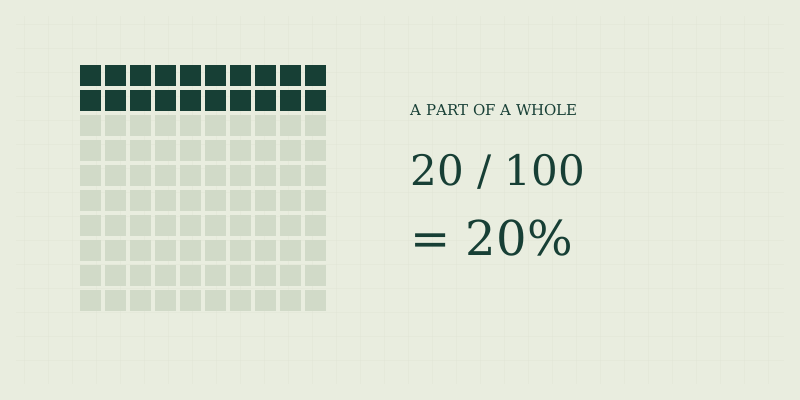
A percentage is a quantity expressed per hundred. To calculate with one, first identify the amount that represents 100%. Finding 20% of 80, finding what percent 20 is of 80, and finding the percentage change from 20 to 80 are three different questions. The numbers alone do not tell you which operation to use.
Three questions, three methods
For a percentage of an amount, multiply the base by the percentage divided by 100. For a part as a percentage of a whole, divide the part by the whole and multiply by 100. For relative change, subtract the original from the new value, divide by the original, and multiply by 100. The original is the reference, not whichever number is larger.
| Question | Illustrative arithmetic | Answer |
|---|---|---|
| What is 20% of 80? | 80 × 20 ÷ 100 | 16 |
| 20 is what percent of 80? | 20 ÷ 80 × 100 | 25% |
| What is the change from 20 to 80? | (80 − 20) ÷ 20 × 100 | 300% |
The last answer exceeds 100% because the increase of 60 is three times the starting value. A percentage larger than 100 is not automatically an error. By contrast, a part larger than its claimed whole may indicate that categories overlap or that the inputs describe different populations.
Work an example from words
Suppose, in an illustrative reading challenge, you finish 18 of 60 pages. The whole is the 60-page assignment, not the 42 pages remaining. Dividing 18 by 60 gives 0.3; multiplying by 100 expresses that ratio as 30%. If the assignment expands to 90 pages, the same 18 pages now represent 20% of the new total. Write a short sentence before calculating: “18 completed pages out of 60 assigned pages.” This keeps unlike quantities out of the denominator. If the numerator is dollars and the denominator is hours, the result is dollars per hour, not an ordinary share of a whole. If both quantities are dollar amounts from different years, check whether the comparison calls for nominal values or another adjustment.
Decimal, fraction, and percentage forms
Twenty-five percent, 0.25, and one quarter describe the same ratio. The percent sign already means division by 100. Enter 25 in a field labeled percentage, because the calculator performs that division. Entering 0.25 in that field means one quarter of one percent. A spreadsheet cell formatted as a percentage may instead expect the decimal ratio; its input convention is a separate interface choice. For a quick mental check, 10% of a positive quantity is one tenth of it, 50% is half, and 100% is the entire quantity. For 20% of 80, twice 8 is 16. If a tool returns 1,600, a division by 100 has probably been omitted. If it returns 0.16, that division may have happened twice.
Make the comparison meaningful
Keep numerator and denominator on the same basis. Comparing one month's count with a full year's total answers a share question; it does not directly describe a monthly growth rate. Combining percentages from differently sized groups requires their underlying counts. A small group's high percentage should not receive the same weight as a much larger group's percentage unless that is the intended statistic. Zero needs special attention. Zero divided by a positive whole is zero percent, but division by a zero whole is undefined. A change from zero to a positive amount has an absolute increase, but the usual percentage-change formula has no finite answer. The calculator rejects that denominator instead of displaying an arbitrary percentage.
A repeatable calculation checklist
- Write the question as a sentence, including the words “of,” “out of,” or “from … to.”
- Identify the reference amount that represents 100%.
- Check that both quantities describe compatible units and periods.
- Convert the percentage to a decimal exactly once.
- Keep unrounded intermediate values until the final reporting step.
- State the result with its unit and its reference amount.
For money, the arithmetic does not establish which items are taxable or which price a coupon applies to. For published statistics, the arithmetic does not establish whether a change is statistically significant. Those questions need information beyond the percentage formula.
Explore the percentage field notes
Use percentage change for before-and-after values, percentage points for changes in rates, and discount math for sale prices. Work backward with reverse percentages, combine groups with weighted-percentages, or check rounding and precision. The percentage calculator implements the basic operations, while Compare methods puts their assumptions side by side.
FAQ
Can a percentage be negative?
Yes. A negative percentage change indicates a decrease when the original is positive. A negative share may be mathematically possible for signed quantities but needs a clear interpretation; it is not a normal count of completed items.
Is 0.5 the same as 0.5%?
No. The decimal 0.5 is 50%. The expression 0.5% equals 0.005. Read the field label before typing and check the displayed formula afterward.
Do I always multiply by 100?
Only when converting a decimal ratio into a percentage. When finding a percentage of an amount, divide the percentage number by 100 before multiplying by the amount.
Sources
- Bureau of Labor Statistics: calculating percent changes — official demonstration of relative change; no CPI values are imported here.
- Sources and methods — source-access date and calculator conventions.
Put the method to work.
Open calculator ↗