
FIELD NOTES / Percentages
Discount math: sale prices and stacked offers
A discount subtracts a percentage of the price it applies to. For an illustrative $80 item at 20% off, the saving is $80 × 0.20 = $16 and the reduced price is $64. That result excludes shipping, taxes, and any charges not included in the discount base. It is a calculation example, not an advertised price.
Find the amount you actually pay
There are two equivalent methods. Calculate the saving and subtract it, or multiply by the fraction of the price remaining. With 20% off, 80% remains, so $80 × 0.80 = $64. The second method is often easier when several discounts apply in sequence.
| Illustrative original | Discount | Saving | Reduced price |
|---|---|---|---|
| $80 | 10% | $8 | $72 |
| $80 | 20% | $16 | $64 |
| $80 | 25% | $20 | $60 |
The table holds the original price constant. Comparing discounts on different original prices requires comparing final totals, not just the percentage printed beside them. A larger discount on a higher original amount can leave a higher price.
Stacked discounts use changing bases
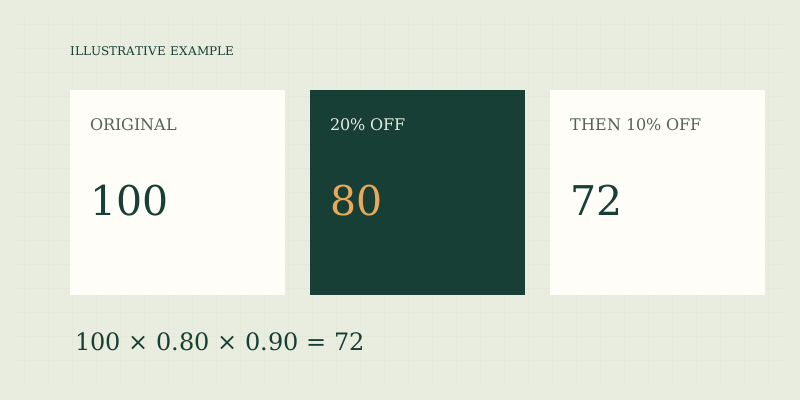
Suppose an illustrative $100 item receives 20% off, followed by another 10% off the reduced price. First, $100 × 0.80 = $80. Then $80 × 0.90 = $72. The combined saving is $28, or 28% of the original, rather than 30%. In general, multiply the remaining-price factors. For discounts a and b expressed as decimals, the combined discount is 1 − (1 − a)(1 − b). This formula assumes both offers apply successively to the same item, without an intermediate minimum price or rounding rule. Actual offer terms may make that assumption false.
Compare dollars off with percent off
For a simple offer applying to the same base, divide the dollar discount by the percentage as a decimal to find the break-even price. An illustrative $15 off and 20% off are equal when the eligible price is $15 ÷ 0.20 = $75. Below $75, $15 off saves more; above $75, 20% off saves more, provided both offers apply without caps. Real offers may have minimum purchases, exclusions, maximum savings, account requirements, or one-use restrictions. A $15 coupon that requires $100 of eligible items cannot be compared as if it applies to a $60 purchase. Check the terms before entering numbers. The calculator does not validate promotion eligibility or fetch coupon rules.
Add charges only on the correct basis
If an illustrative $64 reduced price has a separate $6 delivery charge, the subtotal is $70 before any applicable tax. Whether a particular charge is taxable depends on the relevant rules and transaction. This guide does not provide current sales-tax rates or determine taxable bases. Use the actual checkout or the responsible tax authority for consequential questions. Avoid assuming every fee receives the same discount. A percentage off merchandise may exclude shipping. A service offer may discount labor while leaving parts unchanged. Write each eligible component on a separate line, apply the offer only where appropriate, then add the undiscounted components. This creates a calculation you can reconcile with the final invoice.
Reverse-check a sale price
If a final illustrative price of $64 reflects 20% off, divide by 0.80 to recover the $80 original. Adding 20% to $64 gives $76.80, which does not undo the discount. The recovery percentage is larger because its base is smaller. See reverse percentages for a full method. Round at the point required by the actual transaction. If each item is rounded separately, its final invoice can differ by a cent from a calculation that rounds only the order total. For a mathematical comparison, retain precision through intermediate steps, then label any result rounded to cents. The tool shows an unformatted numerical amount rather than deciding a currency-specific payment rule.
Discount decision checklist
- Identify the eligible original price and whether it already includes another reduction.
- Check minimum spending, caps, exclusions, and expiration conditions.
- Determine whether offers combine or require choosing one.
- Apply successive percentages to the reduced base each time.
- Add undiscounted shipping or other charges separately.
- Compare final totals for the same quantity and specifications.
- Confirm the final checkout amount before paying.
Try discount mode in the percentage calculator. Return to percentage basics to distinguish a saving from a share, or read rounding percentages when small differences appear in a total.
Keep quantity constant
When comparing two offers, calculate the total for the same usable quantity. A lower unit price on a larger package does not necessarily mean a lower checkout total or a better fit for your needs.
FAQ
Do 20% off and 10% off equal 30% off?
Not when applied successively. Their remaining-price factors multiply to 0.72, leaving a combined discount of 28%. An offer explicitly stating a single 30% reduction is different.
Can I enter a discount above 100%?
This calculator rejects it because ordinary sale-price mode assumes a nonnegative price and a reduction no greater than the original. Credits and rebates exceeding a purchase price need a separate cash-flow description.
Is the amount saved the same as the final price?
No. The saving is the original multiplied by the discount fraction. The final price is the original minus that saving. State which figure you are comparing.
Sources
- Sources and methods — elementary arithmetic and the absence of live prices or tax rates.
- Bureau of Labor Statistics: calculating percent changes — reference for expressing a reduction relative to its original base.
Put the method to work.
Open calculator ↗