
FIELD NOTES / Percentages
Percentage points versus percent change
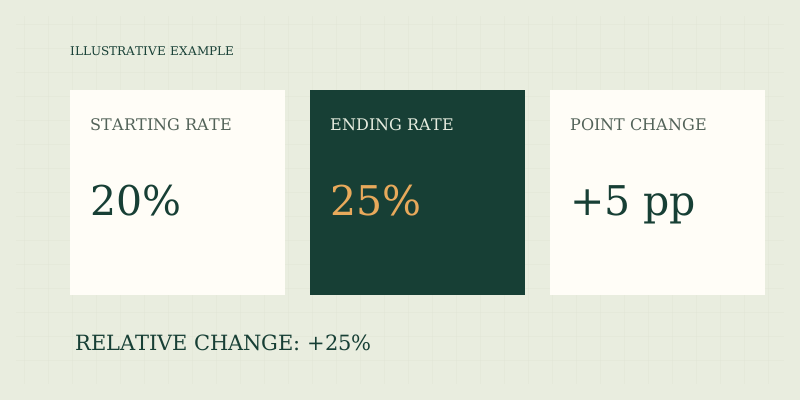
A percentage-point change is the subtraction of two percentages. A percent change divides that difference by the original rate. If an illustrative rate increases from 20% to 25%, the rise is 5 percentage points and a 25% relative increase. Both statements can be correct, but they answer different questions.
Separate the two units
A percentage describes a ratio per hundred. A percentage point describes distance between two percentages on the same scale. You do not divide by the original rate to find percentage points. You do divide by it to describe relative growth in that rate.
| Illustrative rates | Point change | Relative change |
|---|---|---|
| 20% to 25% | +5 points | +25% |
| 50% to 55% | +5 points | +10% |
| 25% to 20% | −5 points | −20% |
The first two rows move by the same number of points. Their relative changes differ because 5 is a larger share of 20 than of 50. Always retain the original rate when deciding whether a relative change is large or small.
Work from counts when possible
Suppose an illustrative workshop has 100 registered participants and 20 complete a project. Its completion rate is 20%. A second workshop also has 100 registered participants, with 25 completions. The rate rises by 5 percentage points. The count of completions rises from 20 to 25, a 25% increase in this particular example because the denominators are equal. Now change the second workshop to 200 participants with 50 completions. The rate remains 25%, so the rate change remains 5 points. But the completion count increases from 20 to 50, a 150% increase. A rate change and a count change can tell very different stories when the population size changes.
Write an unambiguous sentence
Prefer “the completion rate rose from 20% to 25%, an increase of 5 percentage points” when the rate itself is the subject. If relative growth is useful, add “equivalent to a 25% relative increase.” Avoid a bare statement that a rate “rose by 5%” if you mean that it gained five points. For an illustrative rate of 20%, a 5% relative increase produces 20% × 1.05 = 21%. A five-point increase produces 25%. Writing the ending rate exposes the ambiguity immediately. This habit is useful when checking a headline, a classroom report, or an internal dashboard.
Basis points and small rate movements
A basis point is one hundredth of a percentage point. As a mathematical unit, 100 basis points equal 1 percentage point. An illustrative change from 4.00% to 4.25% is 0.25 percentage points, or 25 basis points. Relative to the original 4.00% rate, it is a 6.25% increase. These numbers are unit examples, not current borrowing or savings rates. If a financial document uses basis points, confirm whether they describe a change, a fee, or a spread and what amount that rate applies to. A calculator cannot determine the terms of a financial agreement from the unit alone. Consult a qualified adviser when the interpretation affects a consequential decision.
Avoid misleading comparisons
A point difference does not by itself show whether two surveys or groups are comparable. Check the question, population, time period, and calculation method. A mathematically correct difference may still compare different things. Statistical significance and sampling uncertainty are separate questions; this site does not calculate confidence intervals. When a starting rate is zero, the point change remains easy to state. Moving from 0% to 8% is an eight-point increase. The usual relative percentage change is undefined because its denominator is zero. Do not replace it with 8%, 100%, or an infinity symbol unless the context explicitly defines some other convention.
A quick interpretation checklist
- Are both input numbers rates expressed in percent?
- Does the question ask for distance between rates or growth relative to the first rate?
- Are the underlying populations and periods comparable?
- Would the statement still be clear if the starting and ending rates were shown?
- Are you confusing a rate change with a change in the underlying count?
To calculate relative change with the percentage calculator, enter 20 as the original and 25 as the new value. It will return 25%. Subtract separately to find five percentage points. Read percentage basics for the denominator checklist, percentage change for zero-base limits, and weighted percentages before combining rates from different groups.
Check the implied ending rate
A useful editing check is to reconstruct the ending rate from the sentence. If the original is 20% and the text says a 5% relative increase, multiply by 1.05 to get 21%. If the intended ending rate is 25%, the sentence needs five percentage points instead. This check works even before you inspect a chart, and it helps prevent a mathematically correct calculation from being summarized with the wrong unit in a heading.
FAQ
Is a percentage point a percent of a percent?
No. It is the direct difference between values expressed as percentages. A percentage of a percentage instead multiplies ratios and needs a clearly defined base.
Can I compare rates with different denominators?
You can subtract the displayed rates, but interpreting the difference requires understanding how each rate was produced. Retain the underlying counts and definitions.
Which wording is safer in a report?
Show both rates and label the difference. “From 20% to 25%, up five percentage points” makes the arithmetic clear without requiring readers to infer the reference.
Sources
- Bureau of Labor Statistics: calculating percent changes — relative-change convention used for the comparison.
- Sources and methods — elementary arithmetic and scope.
Put the method to work.
Open calculator ↗