
FIELD NOTES / Units & measures
US cups, fluid ounces, gallons, and liters
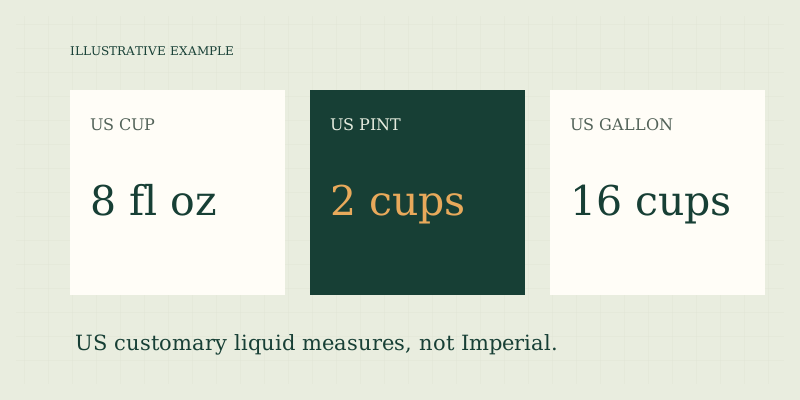
This converter uses US customary liquid volume units. One US liquid gallon is 3.785411784 liters, and one US customary cup is 236.5882365 milliliters. Those definitions are not interchangeable with Imperial gallons, US dry gallons, or every cup used on a label or in a recipe.
Read the qualifier before converting
A gallon without a regional definition is ambiguous. A cup can also mean different volumes in different contexts. Before calculating, look for US liquid, Imperial, metric, or another explicit definition in the source. The converter labels its entries to show which interpretation it uses.
| Supported US liquid measure | Relationship within this system | Metric volume |
|---|---|---|
| 1 tablespoon | 3 teaspoons | 14.78676478125 mL |
| 1 fluid ounce | 2 tablespoons | 29.5735295625 mL |
| 1 customary cup | 8 fluid ounces | 236.5882365 mL |
| 1 liquid gallon | 16 customary cups | 3.785411784 L |
The long decimals are conversion definitions used in software. They are not instructions to measure a kitchen quantity to that many digits. Use precision appropriate to the measuring vessel and recipe.
Work a cup-to-milliliter example
For an illustrative 2 US customary cups, multiply 2 × 236.5882365 = 473.176473 milliliters. This is also one US liquid pint. To convert back, divide by the same cup factor. If the original recipe uses a different cup definition, this result does not apply until that definition is resolved. The tool accepts decimal amounts. One and a half cups becomes 1.5, and three quarters of a cup becomes 0.75. It does not parse a fraction string such as 3/4. Divide the numerator by the denominator first. Do not replace a fraction with a visually similar decimal such as 0.34.
Separate customary cups from label conventions
The cup in this tool is explicitly the US customary cup. Some sources use rounded metric cup volumes or a label-specific convention. This site does not determine which rule a particular product uses. Read the label or recipe standard, and use its stated milliliter equivalent when available. Likewise, a household spoon is not necessarily a calibrated measuring teaspoon or tablespoon. A conversion factor cannot tell you the actual capacity of an unmarked utensil. For a recipe, use the measuring method the recipe specifies. For medicine or safety-critical quantities, follow professional instructions and an appropriate measuring device rather than a kitchen conversion.
A fluid ounce is not a mass ounce
Fluid ounces measure volume. Ounces in the mass group measure avoirdupois mass. Water, oil, flour, and syrup can occupy the same volume while having different masses. Converting 8 fluid ounces to 8 ounces of mass by matching the numbers is not a valid general method. To connect mass and volume, you need a density appropriate to the substance and conditions, or a reliable ingredient-specific measurement. Packing, temperature, and composition may matter. This converter intentionally keeps those groups separate instead of providing a universal fluid-ounce-to-gram button. Read volume and density for the method and limits.
Estimate the answer before accepting it
A liter contains 1,000 milliliters. One US liquid gallon is a little less than four liters, so an illustrative two-gallon result should be a little less than eight liters. A result near 0.008 liters or 8,000 liters indicates a likely prefix or direction error. For small recipe quantities, the exact mathematical equivalent may be less useful than the recipe's tested measurement method. Do not round ingredient amounts casually in a precision-sensitive process. For ordinary planning, label rounded results as approximate and retain the original unit so you can check the conversion later.
A liquid-volume checklist
- Identify the regional definition of gallon, pint, cup, or fluid ounce.
- Confirm liquid volume rather than US dry measure or mass.
- Convert fractions to decimals before entry.
- Keep liters and milliliters separated by a factor of 1,000.
- Use the actual label or recipe convention if it differs from this tool.
- Avoid treating household utensils as calibrated measures.
- Obtain density before moving between volume and mass.
Use volume mode in the unit converter. Read unit basics for compatible units, mass conversion for ounces by mass, and volume and density for ingredient-specific calculations.
Write the system beside a shared recipe
When sending a converted recipe to someone else, include the phrase US customary cup or the actual milliliter quantity. A bare cup label can reintroduce the ambiguity that the conversion was intended to remove. Preserve any ingredient-preparation instructions as well. Changing a unit label should not silently change whether an ingredient is packed, sifted, melted, or measured before another preparation step. Those instructions describe the source measurement and remain relevant after conversion.
FAQ
Can I use these gallons for a UK source?
Only if the source explicitly means US liquid gallons. Imperial gallons use a different definition, which is not offered in this converter.
Why is a cup not displayed as a round metric number?
The tool uses the US customary cup relationship. Other contexts may define a cup differently. Its label is intended to make that assumption visible.
Are dry measuring cups a separate physical quantity?
A measuring vessel still measures volume, but recipe technique and unit definitions must be clear. Do not confuse a cup of a dry ingredient with the separate US dry gallon or with a mass measurement.
Sources
- NIST: SI conversion factors, Appendix B.8 — US liquid conversion reference.
- Sources and methods — liquid-unit definitions and unsupported systems.
Put the method to work.
Open calculator ↗