
FIELD NOTES / Dates & days
Leap years: the Gregorian rule and February 29
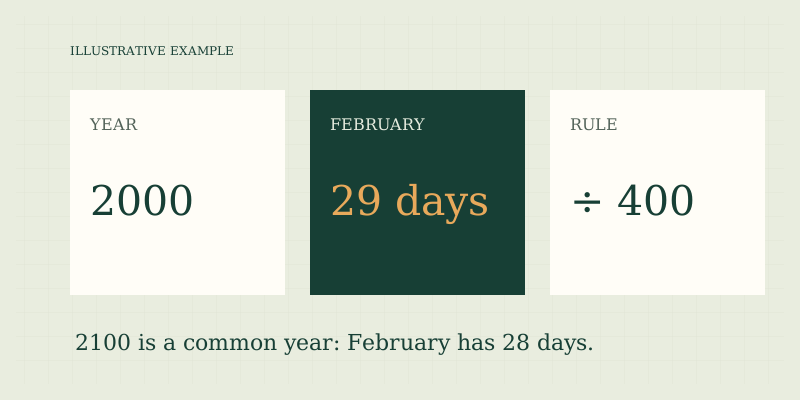
In the Gregorian calendar, a year divisible by four is a leap year except a century year that is not divisible by 400. That makes 2000 a leap year and 2100 a common year. A leap year has February 29, which affects date differences and day offsets crossing that point.
Apply the rule in a reliable order
First ask whether the year is divisible by 400. If so, it is a leap year. Otherwise, if it is divisible by 100, it is not. Otherwise, divisibility by four determines the result. This ordering makes the century exception hard to overlook.
| Illustrative year | Divisible by 4? | Century exception | Result |
|---|---|---|---|
| 2026 | No | Not needed | Common year |
| 2028 | Yes | Not a century | Leap year |
| 2000 | Yes | Divisible by 400 | Leap year |
| 2100 | Yes | Not divisible by 400 | Common year |
These results follow the calendar rule; they are not institutional schedules. A leap-year label does not identify holidays or tell you whether a particular business is open.
Count across February
In an illustrative interval from February 28, 2026 to March 1, 2026, one calendar-day boundary is crossed. In 2028, the same month/day endpoints cross two boundaries: February 28 to February 29, then February 29 to March 1. Including both endpoints adds one calendar date to either elapsed count. This is why a hand calculation that inserts 28 days for every February fails in leap years. It also explains why adding a fixed number of days can land on a different month/day in different years. Let the calendar determine the length rather than adding a blanket adjustment after an already calendar-aware calculation.
A year is not a universal day unit
A common Gregorian year has 365 days and a leap year has 366. An anniversary-to-anniversary interval can include or exclude February 29 depending on the actual dates. Saying one year equals 365 days may be adequate for a stated approximation but is not a general rule for calendar arithmetic. For example, January 1, 2028 to January 1, 2029 spans 366 days. January 1, 2026 to January 1, 2027 spans 365. Both describe one calendar year. If a contract defines a year through a special day-count convention, follow that definition; this date tool does not model financial day-count standards.
February 29 anniversaries need a policy
If an event begins on February 29, a later non-leap year has no date with that month/day. A system adding calendar years must decide whether to use February 28, March 1, or another specified rule. The correct choice depends on the application and any governing instructions. This tool avoids silently deciding that policy by accepting only day offsets. Adding 365 or 366 days is a precise day operation, but it is not a universal implementation of next anniversary. For legal ages, contractual rights, or administrative deadlines, consult the relevant authority rather than generalizing from a calendar example.
Historical calendars are a separate problem
The tool applies the Gregorian rule throughout years 0001–9999. This is a projected Gregorian calendar. It does not reconstruct the calendar that every region actually used at an earlier date. A date in a historical document may follow another calendar or local adoption practice. For genealogical, archival, or astronomical work, preserve the calendar designation in the source. Do not convert a historical date merely by assuming that a modern date input field interprets it correctly. A specialized calendar reference may be necessary. The source linked below explains the modern Gregorian leap-year rule used here.
Leap-year checking worksheet
- Confirm that the task uses the Gregorian calendar.
- Apply the 400-year test before the 100-year exception.
- Verify whether the interval actually crosses February 29.
- Distinguish a calendar year from a fixed number of days.
- Define any February 29 anniversary policy explicitly.
- Use a historical reference when the original calendar matters.
Try February 28 to March 1 in 2026 and 2028 using the date calculator. See date-counting basics for endpoint rules, adding days for offsets, and months versus days for variable units.
Test the century exception directly
A useful software check compares February 28 to March 1 in 2000 and in 2100. The first interval has two elapsed days, and the second has one. Testing only nearby leap years such as 2028 would miss a program that incorrectly treats every fourth year as a leap year. The site's tests include a century boundary for this reason. If you use another calculator, the same pair of examples offers a quick check of its stated Gregorian rule.
FAQ
Is every fourth year a leap year?
Not without the century exception. A year such as 2100 is divisible by four but not by 400, so the Gregorian rule makes it a common year.
Does a leap year change every date interval?
No. It changes a day count only when the relevant interval includes the extra day compared with a corresponding common-year interval. Check the actual endpoints.
Why not always use 365.25 days per year?
An average is not a specific calendar-year length. The Gregorian century rule also means the simple four-year average is not the complete long-cycle rule. Use actual dates for calendar counting.
Sources
- US Naval Observatory: Leap Years — official Gregorian divisibility rule.
- Sources and methods — projected-calendar range and implementation.
Put the method to work.
Open calculator ↗